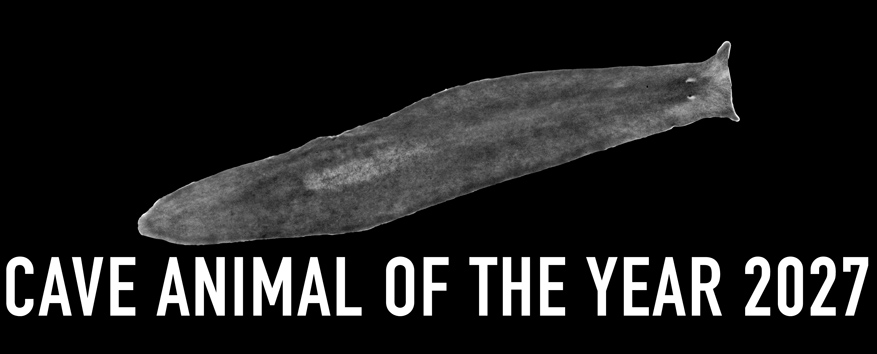
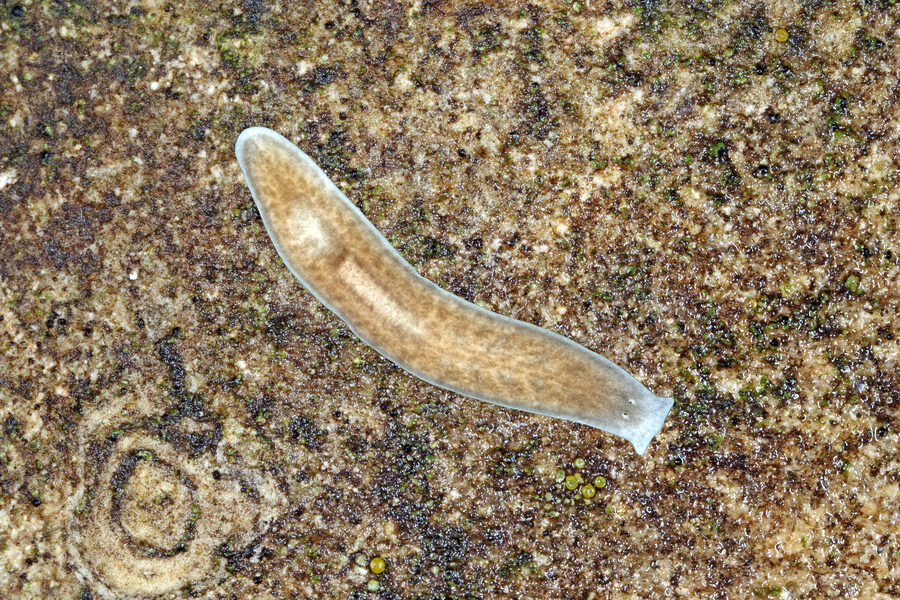
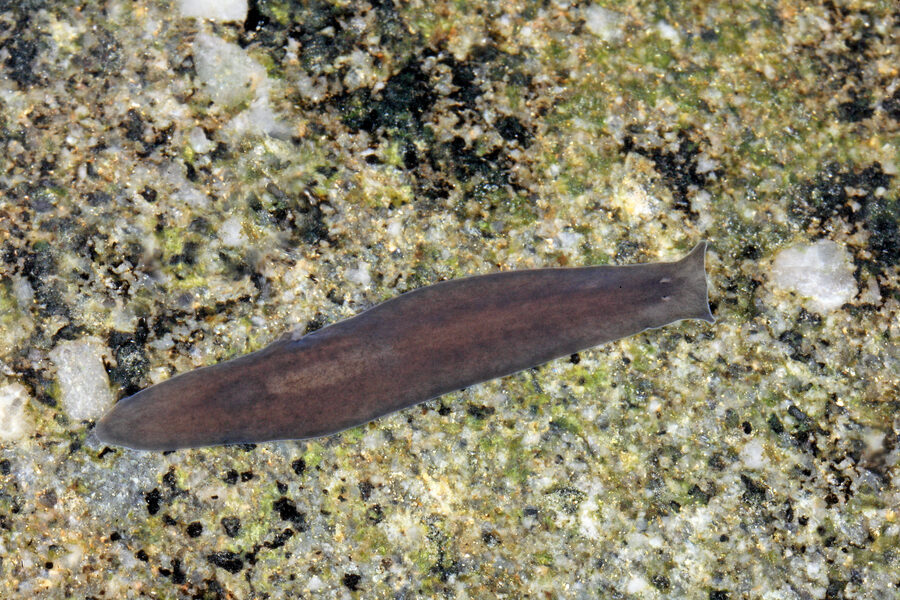
Alpine Flatworm - Cave Animal of the Year 2027
Introduction
The Alpine Flatworm (Crenobia alpina) belongs to the flatworms (Turbellaria) and within them to the family Planariidae. It was first described scientifically by the Italian naturalist Giovanni Pietro Maria Dana in 1766. The species inhabits cold springs, cave waters and groundwater.
The Alpine Flatworm is regarded as an indicator of absolutely clean water and places high demands on water quality. In Central Europe the species is considered a relict of the ice age. In the Alps it still lives in the open, in the upper reaches of streams under stones and among water plants. North of the Alps it has largely withdrawn into the groundwater, but regularly inhabits the cold springs of the low mountain ranges. In the lowlands it is found only rarely. As a cold stenothermic species the Alpine Flatworm prefers temperatures of up to 8 °C. It favours calcareous waters and avoids acidic ones. In caves and mines it is usually found where a flowing connection to the surface exists.
This very refuge is now shrinking. Warmer winters with less snow and dry summers, together with a longer growing season, reduce groundwater recharge. The groundwater warms up, spring discharge declines and more and more springs fall dry completely or temporarily. As a cold stenothermic species the flatworm cannot cope with lastingly warm temperatures. Cold springs that flow all year round are therefore vital to it outside its groundwater habitat.
Because the species spreads only slowly, lost populations are not re-established. From the springs and spring-fed brooks in Wales the Alpine Flatworm disappeared in the early 1990s after a run of unusually warm years with two summer droughts, and it has not returned since. This threat posed by climate change led to the species being chosen as "Cave Animal 2027". It represents the many animal species whose last refuge lies in cold springs and in the groundwater.
The Verband der deutschen Höhlen- und Karstforscher e.V. (German Speleological Society) has chosen the Cave Animal of the Year to point out the immense deficiencies in the research of subterranean ecosystems and their associated faunas.
Description
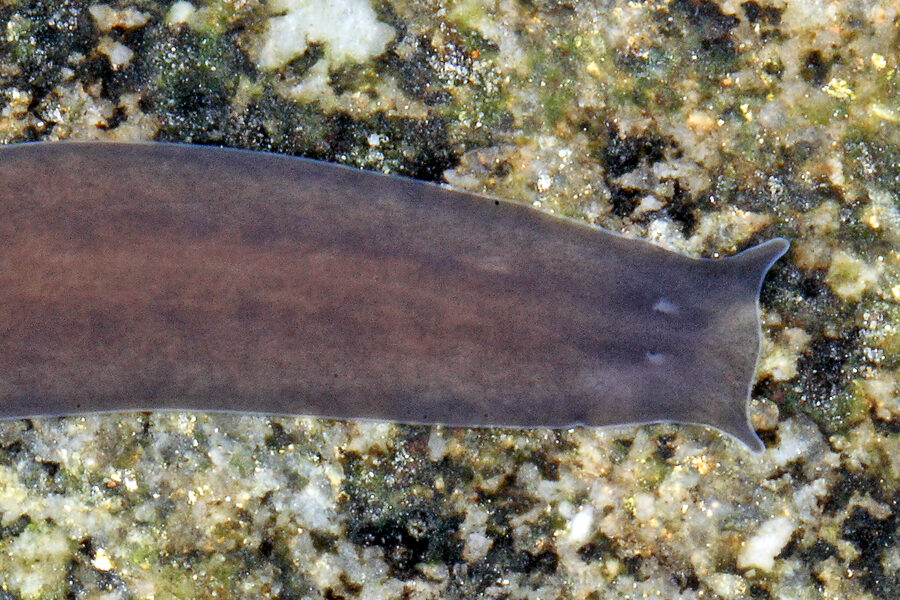
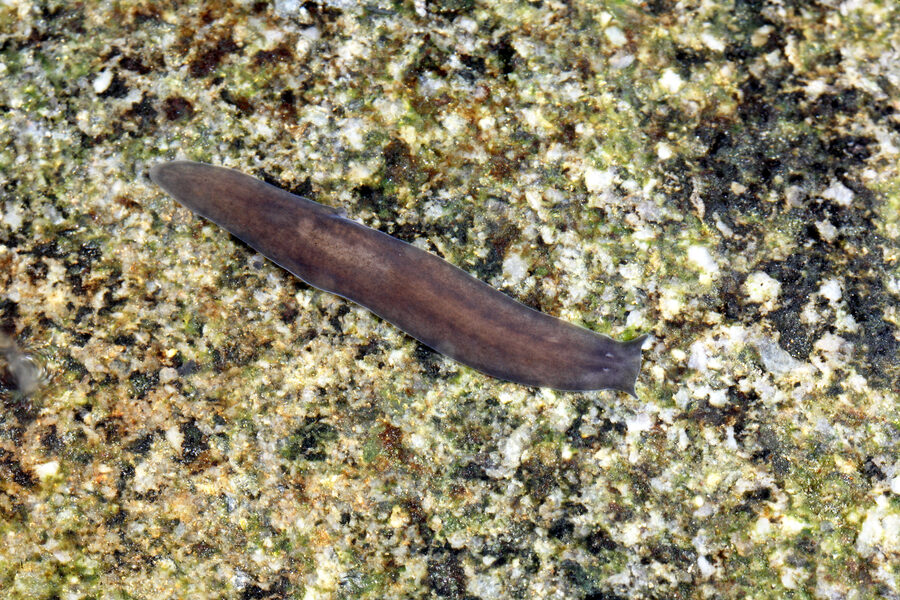
The Alpine Flatworm grows up to 18 mm long. It is usually dark grey or black, more rarely brown, and the underside is always considerably paler. Cave populations can be distinctly paler as well. Two eyes sit on the upper side of the head. The distance between the eyes and the front end is at least three times the distance between the eyes themselves. At the front of the head the animal carries a pair of short, broad and extensible tentacles that project sideways, which makes the head appear truncated.
Sexual reproduction takes place only in winter. The spherical cocoons of about 2 mm, containing up to 50 eggs, are deposited freely. In summer the animals reproduce by transverse fission. Their food consists mainly of small arthropods such as amphipods and aquatic insect larvae, which the light-shy worms capture mostly at night.
In the open the Alpine Flatworm can easily be confused with Polycelis felina, a related planarian carrying numerous eyes. With a hand lens or under a binocular microscope, however, the two species are very easy to tell apart by the number and arrangement of their eyes.
Distribution
The Alpine Flatworm is widely distributed across Europe and northern Asia, but does not occur on the Iberian Peninsula.